


วิทยาศาสตร์ประยุกต์เกี่ยวกับอุปกรณ์ยานยนต์: ระบบซีลไนโตรเจนในถัง – หลักการทำงานและการใช้งาน
2026-09-29 08:56Auto Instrument Popular Science:Tank Nitrogen Seal System – Working Principle & Commissioning
Introduction
Combined with on‑site operation‑and‑maintenance cases of storage tanks, Auto Instrument analyzes the real function and commissioning methods of tank nitrogen‑seal systems as well as root causes of air inhalation even with nitrogen‑seal equipped for tanks fitted with differential pressure level transmitter, tank level pressure transmitter, gauge pressure transmitter and dp transmitter. In combination with the management requirements of pressure transmitter calibration, it helps engineers understand that nitrogen sealing is far more than simple nitrogen filling. Master key points including pressure gradient, valve type‑selection and oxygen‑content judgment to avoid risks such as air back‑suction, pressure fluctuation and material oxidative loss.
I. Industry Fact: Air Can Still Be Sucked into Tanks Equipped with Nitrogen‑Seal Systems
Many field operators simply regard tank nitrogen sealing as “filling nitrogen into the tank”, which is one‑sided. Even with a nitrogen‑seal system put into service, air may still be sucked into storage tanks.
What nitrogen sealing controls is not merely “whether nitrogen exists inside the tank”, but three core elements of the tank‑top gas‑phase space: oxygen content, tank micro‑pressure and gas in‑and‑out paths.
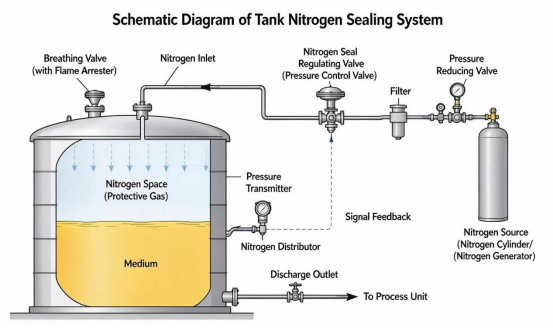
The gas‑phase space on the top of storage tanks is not static. Liquid‑level fluctuation and ambient‑temperature change will alter gas volume and pressure inside tanks. The essence of nitrogen sealing is to maintain low‑oxygen, slight positive‑pressure, discharge‑enabled and monitor‑able operating status amid various working‑condition fluctuations. Liquid‑level data collected by differential pressure level transmitter and tank level pressure transmitter serve as important references for nitrogen‑seal regulation. Regular pressure transmitter calibration shall be performed to guarantee accurate liquid‑level and pressure acquisition, so that real‑and‑valid pressure data from gauge pressure transmitter and dp transmitter can be obtained for thorough understanding of tank nitrogen sealing.
II. Core Highlights: Core Principles and Key Misunderstandings of Tank Nitrogen‑Sealing
1. Nitrogen Sealing ≠ Nitrogen Purging & Displacement
Purging air out of tanks with nitrogen before commissioning is inerting displacement, a one‑off initial treatment to solve gas‑phase composition at startup.
After tanks are formally put into operation, liquid‑level rise & fall, day‑night temperature difference, material receiving & delivery switching and minor leakage of equipment accessories will continuously change pressure and composition of tank‑top gas phase. Continuous regulation shall be realized by nitrogen‑seal systems at this stage.
ssshhh Displacement is a one‑time action; nitrogen sealing is continuous dynamic control.
Confusing the two and only performing nitrogen purging before startup will result in qualified oxygen content at commissioning but gradual oxygen‑content rise after several‑day operation. Pressure readings from gauge pressure transmitter may appear normal while tank‑top gas‑phase composition has gone off‑spec.
Normal pressure reading does not equal effective nitrogen sealing. To judge whether nitrogen sealing works, four indicators shall be checked simultaneously: tank pressure, oxygen content, nitrogen consumption and breathing exhaust status.
2. Tanks Are Always “Breathing”; Nitrogen Sealing Needs Dynamic Response to Working Conditions
During discharging, liquid level drops and tank‑top gas‑phase volume expands. Discharging every 1 m³ of liquid increases gas‑phase space by nearly 1 m³. Without timely nitrogen supplement, outside air will flow backward and raise oxygen content, damaging inert‑gas protection.
During feeding, liquid level rises and gas‑phase space is compressed to exhaust tank‑top gas. For volatile media, exhausted gas carries large amounts of material vapor.
Temperature also causes breathing effect: gas inside tanks shrinks and tank pressure drops at night due to cooling; gas expands and tank pressure rises in daytime due to heating. For outdoor dark‑colored tanks storing materials of high vapor pressure, gas‑volume fluctuation caused by day‑night thermal breathing is quite obvious.
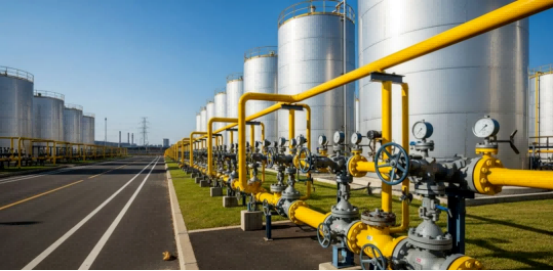
Therefore, nitrogen sealing is not just adding a small amount of nitrogen. It shall dynamically regulate nitrogen supply and exhaust in linkage with liquid‑level signals (differential pressure level transmitter / tank level pressure transmitter) and tank‑pressure signals.
3. Underlying Logic of Nitrogen Sealing: Dual‑Protection of Slight Positive Pressure & Low‑Oxygen
Nitrogen is non‑combustible and hardly reacts with most chemical materials. Injecting nitrogen into tank‑top space aims to reduce oxygen partial pressure in gas phase and minimize contact between materials and oxygen / moisture.
‑ For oxygen‑sensitive materials: restrain oxidation, discoloration, degradation, acid‑value increase and other quality deterioration;
‑ For moisture‑absorbing materials: reduce moisture ingress;
‑ For volatile hazardous materials: keep tank‑top gas phase within safe explosion‑proof range.
Reducing oxygen content alone is insufficient. When internal tank pressure is lower than atmospheric pressure, air will flow backward into tanks via breather valves, flanges, manholes, instrument ports and weak sealing gaps. Nitrogen sealing maintains slight positive pressure to create outward gas trend and block outside‑air back‑suction.
ssshhh Key points for slight positive pressure: higher pressure does not mean better. Atmospheric‑pressure storage tanks shall never be used as pressure‑bearing equipment.
‑ Too low pressure: cannot resist air back‑suction;
‑ Too high pressure: frequent popping‑open of breather valves, sharp increase of nitrogen consumption and extra load on tank body and accessories.
A well‑functioning nitrogen‑seal system is judged by stable pressure rather than high‑pressure value.
4. Pressure Setting Gradient Shall Not Conflict with Each Other
Many failures of nitrogen‑seal systems arise from disordered set‑values of protective components instead of missing valves. A clear pressure gradient must be established among nitrogen‑seal valve, exhaling breather valve, vacuum negative‑pressure protection and safety relief:
1. The nitrogen‑seal valve opens for nitrogen supplement when tank pressure drops to preset positive‑pressure value and closes when tank pressure rises to closing set‑point;
2. Opening pressure for exhaling of breather valve > closing pressure of nitrogen‑seal valve;
3. Negative‑pressure vacuum protection is set within negative‑pressure range, only for emergency protection when nitrogen supplement is insufficient or instantaneous air‑intake exceeds capacity;
4. Safety relief is set at higher pressure for overpressure final‑stage protection.
Too‑small interval between set‑points leads to the phenomenon of “nitrogen supplement and exhaust happening simultaneously”. The nitrogen‑seal valve opens and the breather valve pops open immediately. Symptoms include high‑nitrogen consumption, pressure fluctuation and frequent valve on‑off actions, which root in disordered pressure‑gradient configuration.
The first step for nitrogen‑seal commissioning is to sort out the whole pressure‑setting logic.
5. Nitrogen‑Seal Valve Type‑Selection Shall Not Only Refer to Nominal Pipe Diameter
In field retrofits, people often select nitrogen‑seal valves merely according to nitrogen‑pipe nominal diameter, which is not rigorous.
The core basis for type‑selection is maximum nitrogen‑supplement capacity. Nitrogen‑supplement capacity shall cover three working‑condition scenarios: gas‑phase expansion caused by large‑volume discharging, gas thermal‑shrinkage due to cooling, and allowance for working‑condition switching and instrument regulation.
‑ Undersized valve: tank pressure drops rapidly under large‑volume discharging; vacuum protection triggers in advance and air is sucked backward into tank;
‑ Oversized valve: poor regulation stability under small‑flow conditions, pressure oscillation, frequent valve on‑off actions and fast wear of diaphragm & sealing elements.
For self‑operated nitrogen‑seal valves, impulse‑pipe shall be emphasized. Blockage caused by liquid accumulation or crystallization in impulse‑pipe will make valves obtain false pressure signals. Many field “nitrogen‑seal‑valve‑failure” cases are actually caused by impulse‑pipe blockage by condensate or material crystal.
Qualified nitrogen‑seal valves shall operate stably under small pressure‑difference, small opening and low‑flow conditions instead of being “safer with larger pipe size”.
6. Both Inlet & Exhaust Path Shall Be Guaranteed
Only emphasizing nitrogen‑supply loop while ignoring exhaust path is a frequent design defect.
Feeding, temperature‑rise and material volatilization will raise tank pressure. Excess gas shall be discharged timely via breather valves, tail‑gas pipelines or recovery‑&‑treatment systems.
Blocked exhaust pipeline will lift actual action pressure of breather valves; blocked flame arrester will greatly weaken exhaust capacity.
For volatile materials: excessively‑high nitrogen‑seal set‑pressure or internal leakage of nitrogen‑seal valve will increase total exhaust volume, aggravate material loss and raise load of downstream tail‑gas‑treatment equipment.
Evaluation on nitrogen sealing shall integrate inlet loop, tank‑top gas‑phase space and exhaust loop.
7. Oxygen Content Is Hard Indicator for Nitrogen‑Seal Effect
Pressure transmitters (gauge pressure transmitter / dp transmitter) only feed back tank pressure and cannot reflect real‑tank oxygen content.
Manhole reset after maintenance, residual oxygen at local dead corners, air back‑suction caused by poor breather‑valve sealing and back‑pressure fluctuation of tail‑gas system are failures that cannot be reflected by pressure‑gauge readings.
Oxygen‑content detection is indispensable for oxygen‑sensitive, moisture‑absorbing and highly‑volatile materials. Attention shall be paid to sampling‑point position, dead‑volume of sampling tube, analyzer response time and regular pressure transmitter calibration plus analyzer calibration. Single‑point tank‑top sampling cannot represent all dead corners; readings obtained immediately after opening sampling valve do not stand for real gas‑phase composition inside tank.
Comprehensive judgment on nitrogen‑seal operation status requires combining four sets of data: oxygen content, tank pressure, nitrogen flow rate and tank liquid‑level (from differential pressure level transmitter / tank level pressure transmitter).
1. Discharging: liquid‑level drops, nitrogen‑consumption rises synchronously and tank‑pressure remains stable → normal nitrogen supplement;
2. No receiving‑&‑discharging operation but continuous nitrogen consumption → check valve internal‑leakage, breather‑valve leakage, tank‑top sealing and conflicting set‑values;
3. Slow oxygen‑content rise → check displacement quality, sealing points and action records of vacuum protection;
4. Saw‑tooth tank‑pressure oscillation → check valve type‑selection, impulse‑pipe and control dead‑zone.
Only combining pressure, nitrogen flow rate, oxygen content, valve‑action status and receiving‑&‑discharging working‑condition can tank nitrogen‑seal status be fully evaluated.
III. Scenario Value: Operating Characteristics & Fault Identification of Well‑Functioning Nitrogen‑Seal Systems
A well‑functioning nitrogen‑seal system requires no frequent manual adjustment by operators, with features as follows:
✅ Long‑term stable tank pressure;
✅ Regular action frequency of nitrogen‑seal valve;
✅ No irregular frequent popping‑open of breather valve;
✅ Nitrogen‑consumption matches receiving‑&‑discharging rhythm;
✅ Oxygen‑content stably meets process indicators.
The following phenomena indicate defects in nitrogen‑seal configuration and shall be re‑checked:
❶ Frequent tank‑pressure oscillation up and down;
❷ Frequent on‑off of nitrogen‑seal valve;
❸ Frequent breather‑valve action during normal discharging;
❹ Continuous heavy nitrogen consumption without receiving‑&‑discharging operation;
❺ Oxygen‑content cannot drop to process requirements long after maintenance reset;
❻ Tank pressure abnormally fluctuates along with tail‑gas‑system working‑condition change.
These phenomena cause limited harm separately, but overlapping will lead to material deterioration and potential safety hazards.
IV. Supplementary Conclusion
Tank nitrogen‑sealing is far more than filling nitrogen into tanks; it realizes continuous dynamic control over tank‑top gas‑phase space.
It shall control oxygen content to prevent air ingress; maintain reasonable slight positive pressure instead of blindly raising set‑pressure; guarantee both nitrogen‑supplement capacity and smooth exhaust path; do not merely read pressure data from gauge pressure transmitter, dp transmitter and liquid‑level data from differential pressure level transmitter, tank level pressure transmitter, but also monitor oxygen content and nitrogen consumption; configure breathing‑protection and clarify tail‑gas discharge destination.
Reliable nitrogen‑sealing can steadily keep tank‑top gas‑phase state within process allowable range during every tank feeding, discharging, temperature‑rise and temperature‑drop. Periodic pressure transmitter calibration for supporting instruments shall be implemented to ensure credible pressure & liquid‑level data for nitrogen‑seal regulation.
Auto Instrument provides complete series of tank‑measuring instruments: differential pressure level transmitter, tank level pressure transmitter, gauge pressure transmitter, dp transmitter. In accordance with pressure transmitter calibration specifications, we offer type‑selection, installation and commissioning suggestions for tank nitrogen‑seal projects to avoid risks such as air back‑suction, pressure out‑of‑control and material deterioration.